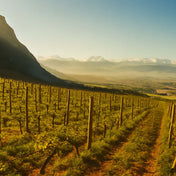
Roussillon is the wine region of the Pyrénées-Orientales department, the southernmost vineyard in France, on the border with Spain. Mountains enclose it on 3 sides: the Corbières to the north, the Pyrenees and Mont Canigou to the west, and the Albères to the south. The Mediterranean closes the fourth side. Three rivers, the Agly, the Têt and the Tech, cut its valleys.
Wine guides often fold Roussillon into "Languedoc-Roussillon," and our Languedoc-Roussillon guide covers the two together. Roussillon has its own history, its own Catalan language and its own appellations, from the sweet wines of Banyuls and Maury to the dry reds of the Agly Valley. For the rest of France, start at our French wine regions hub.
History of Roussillon
The region takes its name from Ruscino, an Ibero-Ligurian town that flourished from the 6th century BC. According to the official rules for Côtes du Roussillon Villages, Greek settlers from Phocaea reached the coast around 600 BC and taught local people to prune vines and make wine. The official rules for Banyuls credit the Phoenicians, who planted vines from the port of Collioure about 7 centuries before Christ.
Benedictine abbeys revived the vineyards in the 9th century, and on the coast growers built terraces from the early Middle Ages, a system the Knights Templar later strengthened.
The Roussillon wine council (CIVR) credits Arnau de Vilanova, physician at the court of the kings of Majorca in Perpignan, with discovering mutage in 1285. Mutage means adding neutral grape spirit to fermenting juice. The spirit stops the yeasts before they turn all the sugar into alcohol, so the wine keeps part of the grape's sweetness. These are vins doux naturels, "naturally sweet wines."
Roussillon was the northernmost outpost of the Catalans. France annexed it in 1659 under the Treaty of the Pyrenees, and the Catalan language and traditions have lasted to this day. The Arago law of 1872 and the Pams law of 1898 gave naturally sweet wines a special tax status, and the Banyuls vineyards turned to them. In 1936 the vins doux naturels of Roussillon became some of the first French wines with a controlled appellation.
Dry wine came later. With the railroad, the vineyard reached its largest size, and growers turned to quality dry wine. Collioure, the dry wine of the Banyuls coast, became an appellation in 1971, and Côtes du Roussillon and Côtes du Roussillon Villages followed in 1977. Maury Sec arrived in 2011.
Dry wines now make up 70 percent of production, according to GuildSomm, and Roussillon still makes 80 percent of France's vins doux naturels, according to the CIVR. Decanter's Stephen Brook named Gérard Gauby's estate in Calce the leading estate of the region and the model for a new generation of dry-wine growers. GuildSomm now calls Calce "ground zero" for natural winemakers.
Terroir of Roussillon
The CIVR describes Roussillon as an amphitheater facing the sea, with vineyards from sea level to 2,130 feet (650 meters).
The Geology of Roussillon
The uplift of the Pyrenees left rocks from every geological era in a small area, according to the official appellation rules. The main soil types, as the CIVR lists them:
- Brown and black schist in the Agly Valley and the Fenouillèdes, in the northwest.
- Decomposed granite and gneiss, called arènes.
- Red clay-limestone and limestone at the foot of the Corbières.
- Yellow and red sandy clay south of the Têt, and clay and sand molasse in the Aspres hills.
- Stony river terraces, and gneiss hillsides in the Albères.
Maury grows on hills of black marl and black schist ringed by garrigue scrub. Banyuls sits on beds of brown schist from the Cambrian period. The official Banyuls rules describe this rock as heavily fractured, with poor soils that hold little water. Growers there farm terraces up to 1,310 feet (400 meters), held in place by dry-stone walls that generations of families built to stop erosion.
Climate and its Influence
Roussillon has a Mediterranean climate: hot summers, mild autumns and winters, and rain that falls mostly in autumn and spring. The sun shines more than 2,500 hours a year, and annual rainfall runs from 18 to 26 inches (450 to 650 millimeters), often in storms that run off the slopes. Average temperatures fall from 59°F (15°C) on the coast to 55°F (13°C) further west.
The defining feature is the tramontane, a dry wind from the northwest. The official Côtes du Roussillon Villages rules count it on about 1 day in 3, and the CIVR puts it closer to 1 day in 2. The wind breaks young shoots in spring and adds to the summer drought. It also keeps the air dry, which limits vine disease and lets growers cut back on vineyard treatments.
The Grapes of Roussillon
Local varieties make up most of the vineyard, and the CIVR calls Roussillon one of the places in the world with the most old vines. Old parcels often mix several varieties together. On the coast, the Banyuls rules tie this to "bail à complant," a system where families owned the vines on land they did not own and replaced dead vines with grafts of their choice.
Red Grape Varietals
- Grenache Noir: the main grape of red Banyuls, Maury and Rivesaltes, and of Maury Sec.
- Carignan Noir: a main grape of the dry reds.
- Lledoner Pelut: in the words of the importer Louis/Dressner, "the ancient Catalan strain of Grenache."
- Syrah and Mourvèdre: allowed in Côtes du Roussillon, Côtes du Roussillon Villages and Maury Sec.
White and Gray Grape Varietals
- Grenache Blanc and Grenache Gris: used for dry whites and for white and amber sweet wines.
- Macabeu: a principal grape of white Banyuls and Maury.
- Tourbat, known locally as Malvoisie du Roussillon, plus Carignan Blanc and Carignan Gris.
- Muscat à Petits Grains and Muscat d'Alexandrie: the 2 grapes of Muscat de Rivesaltes.
The vins doux naturels may use only Grenache, Macabeu, Malvoisie and the 2 Muscats. The IGP Côtes Catalanes allows a wider list, including Merlot, Cabernet Sauvignon, Chardonnay and Sauvignon Blanc.
Top Wines of Roussillon
French wine law sorts wines into tiers. An AOP, or protected designation of origin, sets the area, the grapes, the vineyard rules and the winemaking for each wine. An IGP, or protected geographical indication, gives producers more leeway on grapes and methods. Vin de France, the base tier, only guarantees that the wine comes from France. Roussillon uses all 3.
Banyuls
Banyuls is a vin doux naturel from 4 coastal communes: Banyuls-sur-Mer, Cerbère, Collioure and Port-Vendres. The grapes must reach at least 252 grams of sugar per liter. Producers add neutral grape spirit of at least 96 percent alcohol during fermentation, either to the juice or to the grapes on their skins. The official rules split Banyuls into 2 families. Wines kept away from air hold fresh fruit:
- Rimage, Catalan for "wine of the year," is a red from Grenache Noir, muted on the grapes and bottled within 2 years. It smells of red fruit, cherry and kirsch.
- Blanc is made the same way from white or gray grapes, and rosé is bottled by the end of the year after harvest.
Wines aged with air, in large casks or in glass demijohns left in the sun, take on flavors of candied fruit, prune brandy, honey, roasted coffee and cocoa:
- Ambré comes from white or gray grapes.
- Traditionnel comes mostly from Grenache Noir, which must fill at least 50 percent of the grower's vineyard.
- Hors d'âge, "beyond age," marks an ambré or traditionnel aged at least 5 years.
- Rancio marks wines whose long aging gives the rancio taste, which recalls roasting, dried fruit and walnut.
Maury, Rivesaltes and Muscat de Rivesaltes
Maury makes vins doux naturels from 4 communes northwest of Perpignan: Maury, Tautavel, Saint-Paul-de-Fenouillet and Rasiguères. Maury Grenat tastes of black fruit and garrigue, and Maury Tuilé ages at least 30 months with air and moves toward dried fruit, cocoa and coffee.
Rivesaltes covers 86 communes of the Pyrénées-Orientales and 9 in the neighboring Aude. Rivesaltes Grenat is 100 percent Grenache Noir, with cherry and blackberry, and Rivesaltes Tuilé turns toward cocoa, coffee, tobacco and prune. Muscat de Rivesaltes smells of peach, lemon, mango and mint when young and turns to honey and candied apricot with age. Muscat de Noël, the first Muscat de Rivesaltes of each vintage, goes on sale on the third Thursday of November.
Collioure
Collioure is the dry red and white wine of the same 4 communes as Banyuls. In GuildSomm, Augustin Parcé of Domaine Augustin says the reds vary a great deal between producers, "but the whites are where you find more consistency." Across the border, the Spanish region of Empordà continues the same landscape, part of the Catalan wine country in our Catalonia guide.
Côtes du Roussillon and Côtes du Roussillon Villages
Côtes du Roussillon is the broad appellation for dry red, rosé and white wine. Côtes du Roussillon Villages covers 51 communes in the north of the region and makes only red. 5 named villages can add their name to the label:
- Caramany, on granite and gneiss, where Carignan must go through carbonic maceration. In carbonic maceration, whole bunches sit in a tank filled with carbon dioxide, and fermentation starts inside the intact berries.
- Latour-de-France, with spicy wines built to age.
- Lesquerde, on decomposed granite at altitude, also with carbonic maceration for Carignan.
- Tautavel, on clay-limestone in the Verdouble Valley.
- Les Aspres, the newest, added in 2017 and the only one in the south of the region.
Maury Sec, Côtes Catalanes and Rancio Sec
Maury Sec, the dry red of Maury, is based on Grenache Noir. The rules cap Grenache in the blend, so many Maury growers label their wines Côtes du Roussillon or Côtes Catalanes instead, GuildSomm reports.
The IGP Côtes Catalanes covers the whole department and allows single-variety wines. GuildSomm finds natural wines in this category, especially from Calce. Côtes Catalanes also holds a rare style, the rancio sec. It ferments fully dry and then ages at least 5 years with air, outdoors in barrels left part empty. The wine turns dark amber and smells of roasting, fenugreek, pine resin and walnut.
Cuisine and Typical Products of Roussillon
Catalan dishes fill the recipe list of the CIVR, each paired with a Roussillon wine.
Catalan Dishes
- Cargolade: snails grilled with drops of melted lard, eaten with grilled sausages and black pudding on bread spread with aioli. The CIVR pairs it with Côtes du Roussillon Villages.
- Boles de picolat: meatballs of pork and beef simmered with tomato, dried cèpe mushrooms, green olives, carrots and potatoes, also with Côtes du Roussillon Villages.
- Escalivade: eggplant, peppers, onion and tomato roasted and dressed with olive oil and Banyuls vinegar, served with Côtes du Roussillon rosé.
Typical Products
Anchois de Collioure is a protected geographical indication for anchovies salted in the commune of Collioure. The rules allow one species, the European anchovy, sold whole in salt, as fillets in brine or as fillets in oil.
For dessert, red Banyuls goes with chocolate. Wine Folly singles out the traditionnel, rimage and hors d'âge styles for this match. The CIVR also cooks foie gras with Muscat de Noël.
Natural Wine Producers from Roussillon
We carry these Roussillon growers.
- Domaine Matassa, Calce: Tom Lubbe founded the estate in 2003 after working harvests at Domaine Gauby. He farms organically, with Carignan, Mourvèdre, Lledoner Pelut, Grenache Gris and both Muscats.
- Olivier Pithon, Calce: a grower in the same village as Matassa.
- Domaine de Majas, Caudiès-de-Fenouillèdes: Alain and Agnès Carrère founded it in 1992 and farm organically, mostly Carignan on schist, volcanic stone and mountain limestone.
- Domaine du Possible, Lansac: Loïc Roure started in 2003 with vines in Latour-de-France and works in the old cooperative cellar of Lansac. His farming is certified organic.
- Le Clot de l'Origine, Maury: Marc and Caroline Barriot farm about 25 organic acres (10 hectares) from Salses-le-Château to Caudiès-de-Fenouillèdes and make dry wines and vins doux naturels in their Maury cellar.
- Bruno Duchêne, Banyuls-sur-Mer: dry reds from about 10 acres (4 hectares) in 4 parcels, all on schist.
Common questions about Roussillon wine
Where is Roussillon?
Roussillon is the Pyrénées-Orientales department in the far south of France, on the Spanish border and the Mediterranean coast. Perpignan is its capital. The Corbières massif marks its northern border with the Aude department.
Is Roussillon the same as Languedoc?
No. The 2 regions share a border and many grapes, but Roussillon has Catalan roots and its own appellations. Our Languedoc-Roussillon guide covers the wider area.
What grapes are grown in Roussillon?
Grenache Noir, Carignan, Syrah, Mourvèdre and Lledoner Pelut lead the reds. The whites come from Grenache Blanc, Grenache Gris, Macabeu, Malvoisie du Roussillon, Carignan Blanc and the 2 Muscats.
What is a vin doux naturel?
A vin doux naturel is a sweet wine made by adding neutral grape spirit while the juice ferments. The spirit stops the yeasts, so the wine keeps part of the grape's sugar. Banyuls, Maury, Rivesaltes and Muscat de Rivesaltes are the Roussillon examples.
Why does Roussillon have so many natural wines?
GuildSomm calls Calce "ground zero" for natural winemakers and reports that Maury has drawn newcomers who found Priorat, across the border, too expensive. Many natural growers label their wines Côtes Catalanes or Vin de France, which give more freedom than the AOP rules.
Photo: cocoate.com, CC BY 2.0