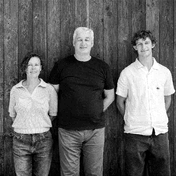
Marco Barba grew up in Madonna di Lonigo, in the flatlands outside Vicenza, surrounded by the white sedimentary soils and volcanic outcrops of eastern Veneto. When elderly widows in his hometown began abandoning their small vineyard plots, he started taking them on one by one, determined to rescue neglected vines and return them to production under biodynamic management.
Backstory
The Marcobarba project launched in 2018, when Marco and his partner Stefano formalized their winemaking collaboration under the shared label. Production takes place at the Menti Giovanni winery in Gambellara, where Marco has access to cellar space and equipment that allows him to handle each parcel separately. The project remains deliberately small and hands-on, with Marco and Stefano—the self-styled "Barbaboyz"—doing most vineyard work themselves. Annual production runs to approximately 40,000 bottles across four cuvées.
The Region
The Marco Barba vineyards span two distinct zones. Around Lonigo, the soils are white sedimentary limestone, well-drained and mineral. In Gambellara, closer to the volcanic Lessini hills, the terrain shifts to dark basaltic rock, giving the wines from those plots a deeper, more brooding character. Both areas sit in the Vicenza province of Veneto, historically associated with Garganega and Durella but home to a broader range of indigenous and international varieties.
Vineyards and Farming
Marco farms all parcels biodynamically, following Rudolf Steiner's principles as the philosophical foundation of his viticulture. Synthetic chemicals play no role in any part of the operation. The vineyards include a mix of white grapes native to the territory—Garganega, Trebbiano, and others—alongside red varieties both local and international, including Rabosco, Merlot, and Cabernet Sauvignon. The oldest vines were planted by the widows whose plots Marco has absorbed into the project, and some date back several decades.
Winemaking
All wines ferment with indigenous yeasts in concrete tanks. White and red wines age for a minimum of six months before bottling, unfiltered. Sulfur additions are kept to a trace amount at bottling only. The pétillant naturel Barbabolla re-ferments in bottle with dried grape juice and is released on its lees without disgorgement, following the ancestral method.
The Wines
Barbabolla is a semi-sparkling white from a blend of native white varieties, vivid and textural with persistent fine bubbles. Barbabianco is the still white counterpart, aged in concrete and bottled with minimal sulfur. Barbarossa is the red, blending native and international varieties from the darker volcanic parcels. Barbagraspa completes the range: a grappa distilled from the aromatic pomace of the Barbabolla harvest using traditional continuous steam distillation.