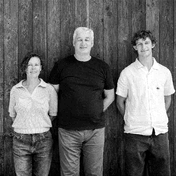
José Carvalho Moreira -- known everywhere simply as Zé -- arrived in Banyuls-sur-Mer in 2010 to play guitar for a harvest party and never really left. Four years later he was making some of the most sought-after natural wines in the south of France.
Backstory
Originally from a small town near Porto, Zé studied cinema and plastic arts before spending three years working on organic and biodynamic farms across Europe. His first encounter with natural wine came through Manuel Di Vecchi Staraz, an Italian winemaker established in Banyuls. Zé converted from skeptic to convert in a single tasting and, after an apprenticeship with Manuel as well as Bruno Duchene and Alain Castex, produced his first vintage in 2014 under the name La Cave des Nomades.
The Region
La Cave des Nomades worked at Banyuls-sur-Mer, at the southern extreme of Roussillon, where the Pyrenees drop into the Mediterranean. The terraced vineyards above the town rest on fragmented schist and limestone at varying altitudes, yielding wines that combine southern ripeness with genuine freshness and minerality. The terrain is too steep for machinery; all vineyard work is done by hand using the traditional Catalan hoe called the xadic.
Vineyards and Farming
Zé farmed three hectares of old vines in twelve separate plots, planted mainly with Grenache Noir, Grenache Gris, Grenache Blanc, Carignan, Mourvedre, and Macabeo, along with small parcels of Syrah, Merlot, Muscat Petit Grain, and Chardonnay. Biodynamic principles guided all vineyard work. The estate became part of Les 9 Caves, a collective production and dining space in Banyuls.
Winemaking
La Cave des Nomades vinified entirely without intervention: no inputs, no sulfur at any stage, no fining, no filtration. Zé used stainless steel, old barrels, and clay amphorae depending on the cuvée. Production was micro-scale, ranging from 300 to 1,200 bottles per wine. Labels were designed in collaboration with artist Katja Stroph and were individually finished -- some printed on cork, a nod to Zé's Portuguese roots. Each label told a different story from his life.
The Wines
The La Cave des Nomades range included Vagamonde, Camino Rojo, Black Unicorn, Épiphénomène Celeste, Amphorisme, and RawZé -- each a distinct expression of terroir and mood. Production ceased when Zé relocated to Portugal to continue his nomadic search for a new home for his wines. We still carry Brutal!!! Vindanger, Intoku and Le Hibou Coyote.
Production has since ended, but we still carry several of these increasingly rare bottles: Brutal!!! Vindanger, L'Arlequin Errant, La Petite Magicienne, Intoku, La Source du Nahual, Le Hibou Coyote, La Decouverte Inattendu, and De Paris a Paris par Mer.