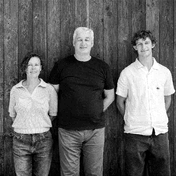
Look closely at a bottle from Weingut Brand and you will find a hand-drawn label by Oma Helga, the brothers' grandmother. The first one she illustrated honored Elis, who once farmed the family's original Sylvaner plot. That mix of family memory and forward-looking natural winemaking sits at the center of everything Daniel and Jonas Brand do.
Backstory
The Brand family has grown wine in Bockenheim for five generations. Their father, Jurgen, moved toward organics in the 1990s, and Daniel (born 1990) brought certified-organic thinking to the farm before he and his younger brother Jonas (born 1994) took over the estate fully in 2014. The same year they began making wines without added sulfur, and in 2015 they were among the first producers in Germany to bottle an officially recognized Pet-Nat. Both brothers worked abroad before coming home, Daniel with Lise and Bertrand Jousset in the Loire and the family drawing inspiration from growers such as Alwin Jurtschitsch in Austria's Kamptal.
The Region
Weingut Brand works at Bockenheim, on the northern edge of the Pfalz, on the Haardtrand where the Palatinate forest meets the vineyards. It is a cooler, limestone-rich corner of the region, well suited to bright, mineral whites. The brothers farm around 18 hectares, including roughly 12 hectares on the limestone slopes of the Sonnenberg, their most important site.
Vineyards & Farming
Weingut Brand is farmed organically, certified from the 2018 vintage, and the brothers borrow freely from biodynamics without treating it as dogma. Vines are strengthened with plant-based preparations such as herbal teas and extracts, and clover and wild herbs are sown between the rows to draw bees and beneficial insects. Riesling and Pinot Blanc lead the plantings, alongside Sylvaner, Pinot Noir, and Cabernet Franc.
Winemaking
In the Weingut Brand cellar the approach is patient and minimal. Each wine ferments spontaneously with wild yeasts, then rests a long time on its lees. Nothing is added and nothing is filtered, and bottling happens when the wine tastes ready rather than on a schedule. The zero-sulfur bottlings carry the label "Pur," and the brothers favor neutral vessels that let the fruit and the limestone do the talking.
The Wines
The Weingut Brand range is crisp, saline, and energetic. Wildersatz is a field blend full of lemon-pith tension; the Pinot Blanc "Pur" and various Riesling cuvees show the cool Bockenheim limestone; and there are reds from Cabernet Franc and Pinot Noir plus a celebrated lineup of pet-nats. Across the board the wines are bright, pure, and unmistakably alive, the work of two young growers who treat a deep family history as a license to experiment rather than a set of rules.