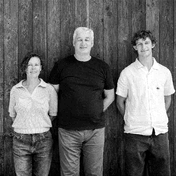
Yann Bertrand grew up in Fleurie but had no intention of becoming a winemaker. He enrolled in commerce studies, traveled the French Alps for a stretch, and eventually found himself working in wine bars and shops, where artisan producers would drop off their bottles and stay to talk. Something shifted. He began to see that winemaking could be practiced with the same passion those producers carried, and he returned to the Beaujolais to find out if he could do the same.
Backstory
Back in Fleurie, Bertrand sought out the region's most rigorous natural winemakers—Jean Foillard, Yvon Métras, and the influential behind-the-scenes figure Jacques Neauport. He learned to see his family's vineyards differently. His parents had been moving toward organic viticulture since taking over the domaine in 1992, and by 2013 the entire estate had achieved organic certification. Bertrand took on an additional 1.5 hectares to farm biodynamically on his own account.
The Region
The Yann Bertrand family Grand Pré block sits in Fleurie, one of the ten Beaujolais crus, with some parcels extending into Morgon. Soils are extremely fine sandy granite, a terroir that gives wines their characteristic floral lift and silky texture. The vines range from 30 to 110 years old, with the oldest plantings offering the concentration and complexity that define the domaine's top cuvées.
Vineyards and Farming
The 7.5-hectare estate is farmed entirely organically, with 1.5 hectares managed biodynamically. Vine density reaches 8,600 to 11,000 plants per hectare, and Bertrand employs the goblet pruning method throughout. Annual production is capped at 30 to 40 hectoliters per hectare, a deliberate restraint that concentrates fruit quality. No oenologist is employed; decisions in the cellar follow the team's own senses and sensations.
Winemaking
Bertrand vinifies with cold carbonic whole-cluster fermentation, a technique developed in the Beaujolais and refined by the generation of producers who taught him. Grapes chill overnight before entering large concrete tanks for 25 days of maceration. Wines then age in small old oak barrels—previously used for other varieties—for 7 to 10 months. No sulfur is added throughout production. Wines are bottled unfined and unfiltered.
The Wines
The Yann Bertrand domaine produces 14 or more distinct cuvées from Fleurie, Morgon, Saint-Amour, Lantignié, and Beaujolais village appellations, virtually all from Gamay. Wines range from fresh and immediately expressive to structured and ageworthy, depending on the vintage and the age of the vines. The range includes a Vin de France blend as well as single-appellation bottlings that rank among the most sought-after expressions of natural Beaujolais.