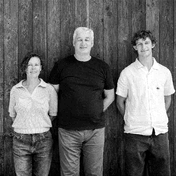
Fabbrica di San Martino sits just inside the city walls of Lucca in Tuscany, completely encircled by woodland — a biodiverse island that has been farmed without chemicals for as long as anyone can remember. Giuseppe Ferrua came to it by accident, following love, and stayed because farming became his life's work.
Backstory
San Martino dates to 1735, when the original farm was established on the outskirts of what was then a thriving silk and weaving city. Giuseppe Ferrua arrived by a more personal route: born in Colombia to Italian parents, he moved to Piedmont as a child and later became a respected restaurateur in South America and Italy. Meeting Giovanna — the farm's third-generation owner — at his Lucca trattoria led him to abandon the restaurant trade in the early 1990s and dedicate himself entirely to the land. He found that the farm had always been worked without chemicals by the contadinos Giovanna's family had employed, and immediately requested organic certification. Biodynamic conversion followed after he encountered Rudolf Steiner's agricultural philosophy.
The Region
San Martino sits in Lucca's surrounding hills, which belong to the Toscana IGT zone, outside the prestige appellations of Chianti, Brunello, and Bolgheri. The estate's isolation within its own circle of woodland creates an extraordinary microecosystem: cattle, vegetables, citrus trees, olives, and vines all coexist on the property without external inputs disrupting the balance.
Vineyards & Farming
Three of the 20 San Martino hectares are under vine, planted with traditional Tuscan field-blend varieties: Sangiovese, Colorino, Canaiolo, Trebbiano, Vermentino, and Malvasia. Some vines in the main parcel, "Arcipressi," are more than 60 years old. Giuseppe does not use tractors: all vineyard work is done by hand, with plant-based compost and biodynamic preparations replacing any synthetic inputs. The estate holds full biodynamic certification.
Winemaking
San Martino fermentation is spontaneous with native yeasts. Nothing is added to the wines at any stage, and there is no filtration. Giuseppe's stated philosophy is straightforward: "We wanted to make an honest wine, nothing more." Whites are fermented in stainless steel to preserve freshness; reds are barrel-aged in neutral vessels that allow the fruit to develop without the imposition of new oak.
The Wines
San Martino produces five wines from the estate's three hectares. "Arcipressi" is the flagship: a field blend of 15 Tuscan varieties co-fermented from the oldest vines, bottled in stainless steel for an approachable, immediate expression of the land. The "Fabbrica Rosso" is a Sangiovese-led barrel-aged red built for more patient cellaring. The estate also produces a white from Vermentino, Malvasia, and Trebbiano, an occasional rosé ("Rosaspina"), and in exceptional vintages a magnum-only reserve called "Rubino."