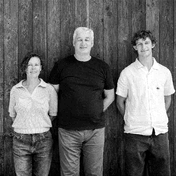
Michel Guignier was not the first to make natural wine in Villié-Morgon. The village had already produced Marcel Lapierre, Jean Foillard, and the rest of the so-called Gang of Four. But Guignier belongs to their generation in spirit, and the fact that he supplied fruit to Marcel Lapierre himself speaks to the quality his vines have long offered. He inherited something worth protecting and he has spent his career protecting it.
Backstory
Guignier represents the fourth generation of a winemaking family in Villié-Morgon, in the heart of Beaujolais. He established his own domaine in 1989, starting with 3 hectares in the Morgon appellation. The estate has grown to 11 hectares and now spans several appellations. He obtained organic certification under the Agriculture Biologique label in 2006, formalizing practices he had long held as personal conviction. His domaine is known as Les Amethystes, named for the amethyst crystals occasionally found in the decomposed granite soils of the region.
The Region
Michel Guignier works at Villié-Morgon, at the center of the Beaujolais cru system, and Morgon is regarded as its most structured and age-worthy appellation. The soils here are dominated by decomposed granite and schist known locally as roches pourries, or "rotten rock," a friable, mineral-rich substrate that gives Morgon wines their characteristic density and grip. The region produces some of France's most compelling Gamay, and in the right hands, wines that can age for a decade or more.
Vineyards and Farming
Guignier's 11 hectares span Morgon, Brouilly, Chiroubles, Beaujolais, Saint-Amour, Fleurie, Moulin à Vent, and Macon Villages. His oldest vines reach 70 years of age, all tended by hand, with grasses, herbs, and wildflowers planted between rows. The estate is ploughed and composted regularly. No synthetic plant protection products have been used since conversion to organic farming.
Winemaking
Guignier vinifies using indigenous yeasts exclusively, which he views as essential for transmitting the character of the soil. Whole bunches go through a vertical press; the gentle, slow pressing preserves purity. Maceration runs 6 to 7 days for the village Beaujolais and up to 14 to 15 days for the top Morgon cuvees. Wines are aged on the lees in old neutral Burgundy barrels for between 5 and 15 months, with both alcoholic and malolactic fermentation occurring in barrel. Sulfur is applied selectively, post-malolactic, but not systematically. Light diatomaceous earth filtration is used at bottling for some cuvees; others go out unfined and unfiltered.
The Wines
The range covers the full sweep of appellations Guignier farms: Beaujolais AOC from 50-year-old vines, Morgon Vieilles Vignes from 60 to 70-year-old vines, Morgon Roche Pilee, and the top-of-range Morgon Canon, made from the most distinctive parcels and aged longer in barrel. Each wine reflects the distinct personality of its soil, from the lighter, more perfumed Chiroubles to the structured, mineral depth of Morgon.