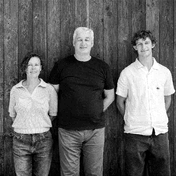
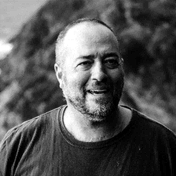
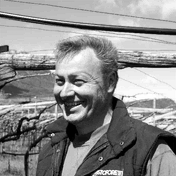
In the small valleys of the middle Ardèche, where the limestone and basalt plateaus descend toward the Rhône, Gilles Azzoni began making wine without any additions in the year 2000. What he started as a personal conviction has become one of France's most quietly influential natural wine estates, passed now to his son Antonin, who inherited both the vines and the philosophy.
Backstory
Gilles Azzoni began farming organically at Mas de la Bégude in 1983, converting to natural vinification in the late 1990s after abandoning industrial methods. In 2000 he launched Le Raisin et l'Ange from Saint-Maurice-d'Ibie, making wines without sulfur, filtration, or any other addition, and joined the AVN (Association des Vins Naturels), France's leading natural winemakers group. In 2014, Gilles and his son Antonin transitioned the project to a négociant model, purchasing organic fruit from trusted neighbors in the southern Ardèche near Vallon-Pont-d'Arc. Antonin took over primary responsibility for the wines in 2015, with Gilles officially retiring after the 2023 vintage.
The Region
Le Raisin et l'Ange works in the southern Ardèche, a landscape of dramatic gorges and hidden valleys, part of the Massif Central's volcanic edge where basalt, limestone, schist, and granite all appear within short distances of one another. The region benefits from a Mediterranean influence that brings warm days and sunshine, tempered by altitude and the cooling effect of river valleys. It sits administratively within the broader Rhône appellation zone but maintains its own distinct identity.
Vineyards and Farming
For Le Raisin et l'Ange, Antonin maintains a small family plot in addition to sourcing from neighboring growers, all farming organically. Soil management involves minimal tillage at the vine base, occasional light cultivation between rows, limited manure application every three years, and selective biodynamic preparations, applied pragmatically rather than as a strict system. The family has not added sulfur to their wines or filtered for close to twenty years, one of the longest unbroken commitments to this standard in the region.
Winemaking
All wines are fermented with wild indigenous yeasts and produced without sulfur dioxide, without fining, and without filtration. Winemaking is designed around a "companion" philosophy, with Gilles describing the winemaker's role as accompanying the wine rather than transforming it. Spontaneous fermentation proceeds without temperature control in a range of vessels depending on the cuvée.
The Wines
The range includes Fable (white), Nedjma (white), Pause Canon (red), and Brân (red), each made from grapes that express the schist, limestone, and granite soils of the Ardèche. The wines are SO2-free, vivid, and marked by the kind of natural energy that comes only from grapes grown without chemical shortcuts in land that has been respected for generations.