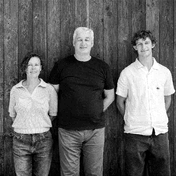
Fifty square kilometres of grain fields separate Lamoresca from its nearest winery neighbour in central Sicily — which suits Filippo Rizzo perfectly. Isolation, he has shown, breeds originality: a tiny operation producing a handful of wines that carry the warm, sandy character of this forgotten corner of the island with complete conviction.
Backstory
Lamoresca founder Filippo Rizzo grew up in San Michele di Ganzaria in the Gigliotto district of central Sicily. He moved to Belgium, married his Belgian wife Nancy, and opened a restaurant in Brussels focused on traditional Sicilian cooking — one of the first venues outside Paris to champion natural wines. His wine sales representative at the time was Frank Cornelissen, then beginning his own work on Etna. When Filippo decided to return to Sicily to make wine himself, Cornelissen let him use his cellar for the first two vintages while Filippo completed his own cantina. Production began in the early 2000s.
The Region
Lamoresca sits where the provinces of Catania and Enna meet at the Elsa river, roughly midway between Etna and the Vittoria plains. The elevation of 450 metres delivers cooling nights that temper the intense Sicilian heat. Soils are compact sandstone mixed with calcium and iron-rich clay — a combination that imparts both structure and aromatic intensity to the wines. The estate later acquired Monte Stagno, a 100-metre hill across the Elsa for biodiversity conservation.
Vineyards and Farming
Lamoresca encompasses 11 hectares, with four dedicated to vines; the remainder is olives, wild herbs and native trees that Filippo maintains deliberately to counter the surrounding monoculture. All viticulture is certified organic: no chemicals, no pesticides, every vine worked by hand. Varieties are the indigenous southern Sicilian palette: Frappato, Nero d'Avola, Nerello Mascalese, Moscato, Vermentino and Catarratto. Filippo's son Simon has joined the team, managing communications while learning winemaking from his father.
Winemaking
Lamoresca works with natural fermentation without temperature control, minimal intervention and sulfur used only when strictly necessary. Concrete ageing preserves freshness while softening the wines' sandstone tannic grip.
The Wines
Lamoresca Rosato blends Nero d'Avola, Frappato and Moscato into a vivid, saline pink. Nerocapitano is a concrete-aged Frappato of fragrant lightness. The Rosso combines Nero d'Avola and Frappato for deeper, spiced structure. A Bianco from Catarratto and Vermentino and the Elsa Rosso complete the small, tightly focused lineup.