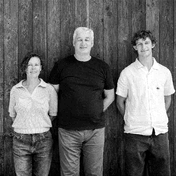
Philippe Wies came to wine through an unusual route: he and his wife Céline were market gardeners before they became vignerons. After working the land in the Ardèche, they relocated to Saint-Paul-de-Fenouillet in the Maury appellation of Roussillon, where the terroir — black schist cliffs, maquis scrubland, Pyrenean light — spoke to something they wanted to cultivate. That was in 2007. La Petite Baigneuse (The Little Bather) has been producing some of the Roussillon's most distinctive natural wines ever since.
Backstory
The La Petite Baigneuse project began with 8.5 hectares near the village of Saint-Paul-de-Fenouillet and has grown to 14 hectares. Philippe previously worked in livestock farming and rural accommodations before committing fully to viticulture. From the start, the approach was radical: no sulfur additions on any cuvée, no fining, no filtering, and a progression toward full agroforestry — with 35 percent of the vineyard rows already underplanted with trees as of recent vintages.
The Region
Maury sits in the southeastern corner of the Roussillon, sheltered by limestone ridges and dominated by black schist soils that radiate heat during the day and lose it rapidly at night. The appellation is best known for its fortified Maury wines, but the same schist — mineral-dense and well-drained — produces exceptional dry reds and whites when farmed with care. The vineyards at La Petite Baigneuse sit at approximately 350 meters elevation, protected by a range of cliffs.
Vineyards and Farming
La Petite Baigneuse holds organic (AB), biodynamic (Demeter), and Biodyvin certifications. The vineyards are planted to Lledoner Pelut (a local variant of Grenache), Grenache Noir, Carignan, Macabeu, Syrah, Grenache Gris, and Oeillade. Some 35 percent of vines exceed 100 years in age. Soils are covered at all times, hillside work is done manually, and no chemical inputs of any kind are used.
Winemaking
La Petite Baigneuse ferments in concrete vats using only ambient yeasts. Whites are aged in stainless steel; reds mature in 30-hectoliter oak barrels. The cellar is designed to operate entirely by gravity. No additives are used, and sulfur is added to none of the wines. Annual production is approximately 30,000 bottles.
The Wines
The La Petite Baigneuse portfolio spans a broad range of styles, from the fresh, mineral whites of Trinquette and Sapristi, to the structured reds of Grand Largue and Juste Ciel. Les Loustics is a lighter, approachable entry point, while Grain de Soleil showcases the estate's skin-contact white work. Every cuvée carries the clean, saline mineral signature of the Maury schist.