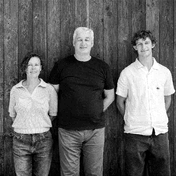
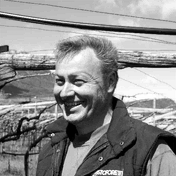
Giuseppe Russo trained as a classical pianist before his father's death in 2003 pulled him back to the family land in Passopisciaro, on the northern flank of Mount Etna.
Backstory
Russo took over the estate, named for his late father Girolamo, and from 2005 began bottling under his own label. Where his father had sold grapes and farmed conventionally, Giuseppe steered the property toward organic viticulture and single-contrada wines. His patient, site-driven approach helped define Etna's modern revival and made him one of the appellation's most respected names.
The Region
Girolamo Russo farms Etna's northern slope, one of Italy's most distinctive growing zones. The volcano has erupted for hundreds of thousands of years, leaving sciare, the cooled lava flows, and soils of black volcanic ash rich in minerals. High elevation and wide day-to-night temperature swings give the wines tension, perfume, and lift rather than weight. The vineyards are organized into contrade, named districts that function much like the crus of Burgundy, each with its own soil, exposure, and altitude.
Vineyards & Farming
The estate spans roughly 15 to 16 hectares across the contrade of San Lorenzo, Feudo, Feudo di Mezzo, and Calderara Sottana, planted between 650 and 780 meters of elevation. Vines are old. San Lorenzo holds parcels of 80-year-old plants at around 750 meters, and Russo farms one tiny parcel of pre-phylloxera bush vines over a century old. Most are trained in the traditional alberello, or free-standing bush, form. The vineyards are certified organic.
Winemaking
Russo treats each contrada as its own wine, fermenting parcels separately on indigenous yeasts to capture the differences between sites. The reds rest in large and second-passage Slavonian oak, often around 18 months, aiming for transparency to place rather than oak signature.
The Wines
Reds are built on Nerello Mascalese with a measure of Nerello Cappuccio; the whites center on Carricante alongside native varieties such as Catarratto, Grecanico, and Minnella. The entry to the range, 'a Rina, blends fruit from several contrade, which Russo describes not as basic but as a harmony of his sites. Above it sit the single-contrada bottlings of San Lorenzo, Feudo, and Calderara Sottana, the most expressive being the old-vine San Lorenzo Piano delle Colombe.