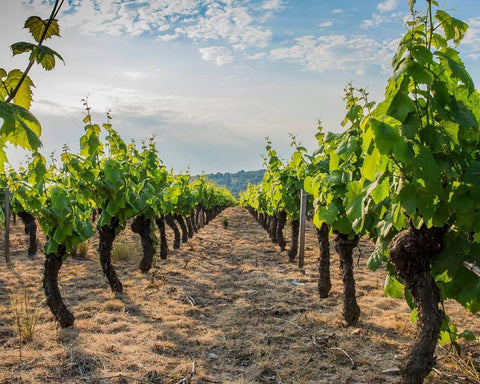
Beaujolais sits just south of Burgundy, rolling down toward the city of Lyon in eastern France. It built its name on one grape, Gamay, and on wines you can drink young: bright, juicy, low in tannin, easy to pour. For years that reputation worked against it, thanks to the marketing circus around Beaujolais Nouveau. Look past the November hype and you find something better. This is the region where natural wine, as we drink it today, began.
Shop our Beaujolais selection
Bright, chillable Gamay from natural growers, including the cru villages of Morgon, Fleurie and Côte-de-Brouilly.
Explore Beaujolais winesWhere Beaujolais is, and why it tastes the way it does
The region runs about 34 miles north to south, between Mâcon and Lyon. The split that matters is geological. Northern Beaujolais sits on pink granite and schist, soils that drain fast and push Gamay toward structure and depth. This is where the ten crus live. The flatter south runs on clay and limestone, which gives softer, fruitier wine meant to be drunk within the year. Most Beaujolais Nouveau comes from there.
The climate is semi-continental, with warm days and cool nights through the growing season. That swing keeps acidity high while the fruit ripens, which is exactly what Gamay needs to stay fresh rather than flabby.
Gamay and carbonic maceration
Gamay is a thin-skinned red with naturally high acidity and modest tannin. On its own it makes light, perfumed wine. What gives Beaujolais its signature is how the grapes ferment.
Most of the region uses carbonic or semi-carbonic maceration. Whole, uncrushed bunches go into the tank, the vat fills with carbon dioxide, and fermentation starts inside each intact berry before the yeast ever touches the juice. The result is the candied-red-fruit lift you taste in a good Beaujolais: cherry, raspberry, a little banana and bubblegum on the simpler wines, with tannins kept soft. Push the technique toward the granite crus and you get something that still carries that fruit but can age for a decade.
The birthplace of natural wine
Here is the part most guides leave out. In the 1980s, a Beaujolais grape-grower and chemist named Jules Chauvet argued that wine had lost its way: too much sulfur, too many additives, cultured yeast flattening everything into sameness. He pushed for the opposite. Farm organically, harvest clean fruit, ferment with the wild yeast already on the grapes, and add little or no sulfur dioxide.
A young vigneron in Morgon named Marcel Lapierre took those ideas and ran. By the mid-1980s he was making cru Beaujolais with no added sulfites and native fermentation. Three neighbors followed: Jean Foillard, Jean-Paul Thévenet, and Guy Breton. The American importer Kermit Lynch called them the Gang of Four, and their wines lit the fuse for everything we now call natural wine. So when you drink low-intervention Gamay from Morgon, you are drinking from the source.
The three styles: Nouveau, Villages, and Cru
Beaujolais Nouveau is released on the third Thursday of November, weeks after harvest. It is meant to be young and gulpable, a celebration of the vintage rather than a serious bottle. Fun, rarely deep.
Beaujolais Villages comes from 38 communes with better sites. It carries more fruit and a little more grip than basic Beaujolais AOC, and it drinks well for a few years.
Cru Beaujolais is the top tier and the reason to pay attention. Ten named villages in the granite north each make wine under their own appellation, with enough structure to reward a few years in the cellar.
Beaujolais Nouveau: the hype and the history
For one night every November, the world drinks Beaujolais. Bottles ship the moment the law allows, posters go up reading "Le Beaujolais Nouveau est arrivé," and importers once raced to fly the first cases to Tokyo and New York. The merchant Georges Duboeuf turned that release into a global event, and for a while it made the region rich.
It also nearly broke its reputation. Growers planted for volume, not quality, and oceans of thin, candy-sweet Nouveau taught a generation of drinkers that Beaujolais meant cheap. By the early 2000s the region was sitting on unsold surplus and a bruised name. The serious growers, many of them in the crus, spent the next two decades pulling Beaujolais back toward what it does best: site-driven Gamay made with care. Enjoy the Nouveau for what it is, a harvest party in a glass. Just do not mistake it for the region.
The ten crus of Beaujolais
- Saint-Amour: floral and lightly spiced, with a delicate frame.
- Juliénas: deeper red fruit and spice, often fuller-bodied.
- Chénas: the smallest cru, earthy and floral with real concentration.
- Moulin-à-Vent: the most powerful and age-worthy, firm enough that people call it the King of Beaujolais.
- Fleurie: silky and perfumed, true to its name.
- Chiroubles: the highest in altitude, light and fresh with bright acidity.
- Régnié: the newest cru, balanced between fruit and spice.
- Morgon: rich and structured, home of the Gang of Four. Its Côte du Py slope is famous for wines that taste almost Burgundian with age.
- Brouilly: the largest cru, broadly fruity and approachable.
- Côte de Brouilly: blue volcanic stone gives these wines a mineral edge the others lack.
How long Beaujolais ages
Most Beaujolais is built for the near term. Drink Nouveau within a few months and basic Beaujolais inside a year or two, while the fruit is loud. Villages will hold for three or four years. The crus are where patience pays. A good Morgon, Moulin-à-Vent, or Juliénas can rest five to ten years or more, trading its bright cherry for darker fruit, earth, and the kind of savory depth that makes people mistake it for older Burgundy. If you want to see what Gamay can become, buy two bottles of a cru, drink one now and forget the other for five years.
What to drink it with
Low tannin and high acidity make Beaujolais one of the most flexible reds at the table. Pour basic Beaujolais and Villages slightly chilled with charcuterie, roast chicken, pork, mushroom dishes, or a board of soft cheeses. It even holds up to salmon, which most reds cannot. For the heartier crus, Morgon and Moulin-à-Vent have the body for duck, braised meats, and aged hard cheese. When in doubt, treat a good Gamay the way you would a lighter Pinot Noir.
How to serve it
Serve Beaujolais cool, around 55°F. Room temperature flattens the fruit and makes the alcohol stand out, so give even the crus fifteen minutes in the fridge before pouring, longer on a hot day. The lighter the wine, the cooler it likes to be. Older cru bottles benefit from a short decant to open up, but most Beaujolais asks for nothing more than a glass and someone to share it with.
Where to start
Skip the Nouveau and reach for a cru, ideally from a grower farming organically and fermenting with native yeast. Morgon and Fleurie are the easiest first steps: one for structure, one for charm. From there, work through the other eight and you will taste how much the granite, the slope, and the hand of the winemaker change a single grape. You can explore Gamay and the rest of our French natural wines to find a bottle from a grower we trust.
Want to taste Beaujolais for yourself? Browse our Beaujolais wines from small natural growers.


